
Understanding Peptide Purity: What Percentages Actually Measure
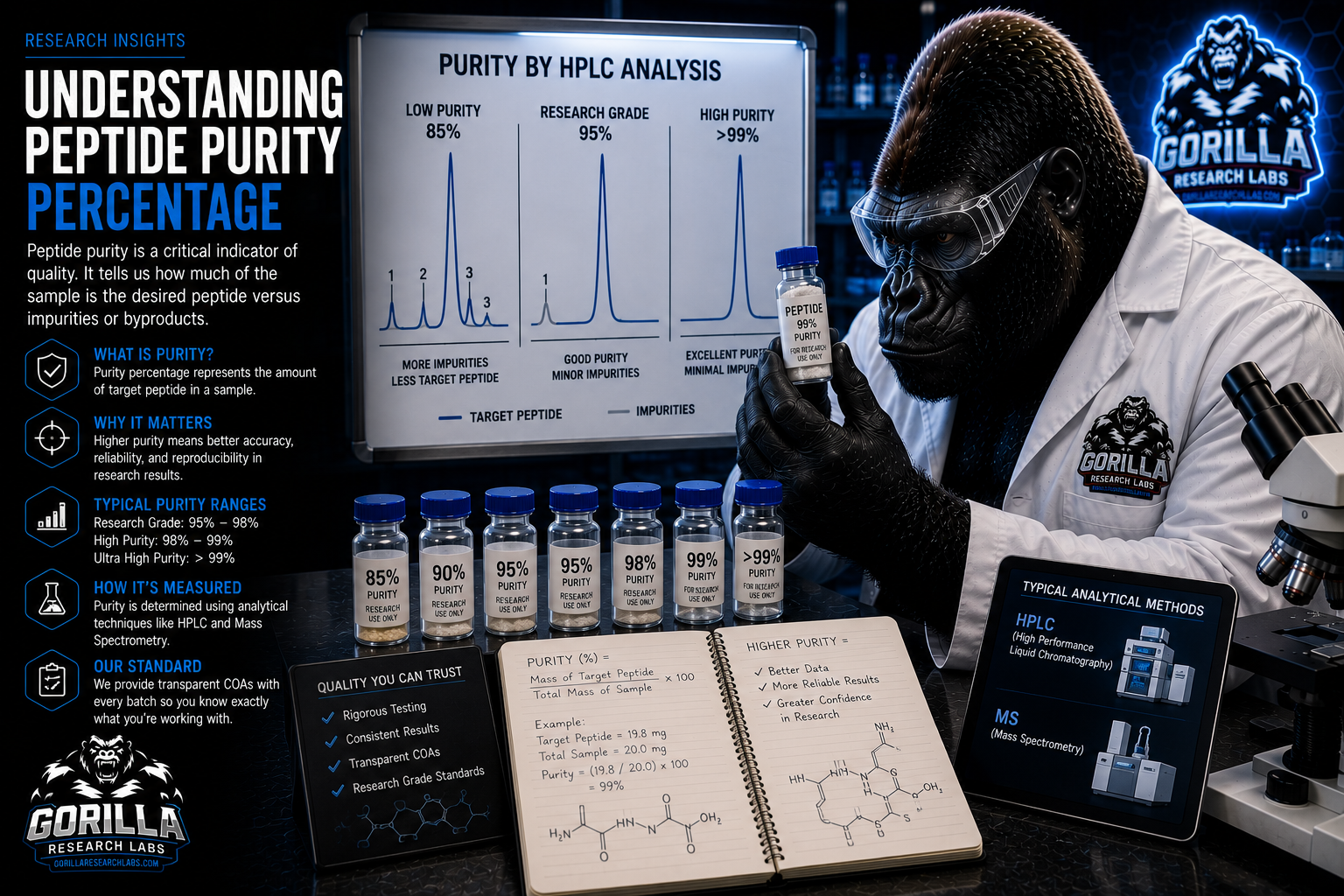
Our earlier piece on reading a certificate of analysis (COA) treated purity as a single number on a spec sheet. In practice, that single number hides several very different measurements. Two research peptides can both list "98% purity" and still be materially different materials in the vial. If you evaluate suppliers or reconcile lot-to-lot records, the gap between those measurements matters. Here is what a peptide purity percentage actually describes, and what it quietly leaves out.
Chromatographic purity is a relative measurement
The figure most COAs headline is chromatographic purity, usually from reversed-phase HPLC. It answers a narrow question: of everything the detector saw, what fraction was the target peak? If the main peak accounts for 98% of the total absorbance area, the material is reported as 98% pure by HPLC. The important word is relative . HPLC purity is a ratio of peak areas, not an absolute count of molecules. It is blind to anything that does not respond at the detection wavelength, and it is sensitive to method choices: column chemistry, gradient, wavelength, and how peaks are integrated. A peptide can look cleaner or dirtier depending purely on how the analysis was run. That is why a percentage is only interpretable alongside the method that produced it.
Net peptide content answers a different question
Net peptide content (sometimes "peptide content" or "assay") measures how much of the total mass in the vial is actually peptide backbone, as opposed to everything traveling with it. This is typically the smaller, more sobering number, and it is frequently absent from the same COAs that advertise a high chromatographic figure. A material can be 98% pure by HPLC and still be, say, 80% peptide by mass, because the remaining 20% is not impurity in the chromatographic sense at all. It is water, bound salts, and counterions that legitimately co-package with the compound. Both numbers are honest. They simply answer different questions: one about the relative cleanliness of the peptide fraction, the other about how much peptide a given mass represents.
Counterions, salts, and residual solvents
Synthetic peptides are usually isolated as salts. During purification, acids such as trifluoroacetic acid (TFA) or acetate pair with basic sites on the molecule, and those counterions stay bound to the finished material. They are not contamination; they are part of the isolated form. But they add mass that is not peptide, which is exactly why net content diverges from chromatographic purity. Alongside counterions, a COA may report: • Water content — often by Karl Fischer titration; lyophilized material readily takes up moisture. • Residual solvents — traces of acetonitrile, TFA, or other processing solvents left after drying. • Counterion identity and level — TFA versus acetate salts differ in mass contribution and in how they present on analysis. None of these appear in a headline HPLC purity number, yet all of them affect what is physically in the container.
Why two "identical" percentages can differ
Put the pieces together and it becomes clear how two products listing the same percentage can be genuinely different: • Different measurements share a label. One vendor's "purity" may be chromatographic; another's may fold in net content. The word alone does not tell you which. • Different methods, same target. Two HPLC purities are only comparable if the column, gradient, and detection are comparable. • Different salt forms. A TFA salt and an acetate salt of the same sequence carry different non-peptide mass at identical chromatographic purity. • Different what-was-tested-for. A COA reports only the impurities the method resolves; missing an analysis is not the same as passing it. The practical takeaway extends the COA article's core point: treat a purity percentage as a claim that must be qualified, never a standalone grade. Ask which measurement the number represents, which method produced it, and whether net peptide content and counterion data accompany it. A specification is only as meaningful as the analytics behind it, and a fully documented 95% can describe a better-characterized material than an unqualified 99%.
Reading the full specification
For research recordkeeping, the strongest practice is to capture the whole picture rather than a single figure: chromatographic purity with its method , net peptide content, water and residual-solvent data, counterion identity, and the supporting analytical traces such as HPLC and mass spectrometry. Logged together, these let you compare lots and suppliers on a consistent basis instead of comparing percentages that were never measuring the same thing. For laboratory research use only. Not for human or animal consumption. Not a drug, supplement, or medical product. No statements have been evaluated by the FDA, and nothing here is intended to diagnose, treat, cure, or prevent any disease. This article discusses analytical specifications and chemical identity only.
References
- National Center for Biotechnology Information — Peptides (StatPearls)
- PubMed — Therapeutic peptides: current applications and future directions
- PMC — High-performance liquid chromatography (HPLC) principles and practice
- U.S. FDA — Analytical Procedures and Methods Validation for Drugs and Biologics
- U.S. FDA — Q6A Specifications: Test Procedures and Acceptance Criteria
Authoritative sources cited for research context. Research use only — not medical advice.