
Endotoxins and Sterility in Research Materials: An Educational Primer
Why endotoxins matter in the lab
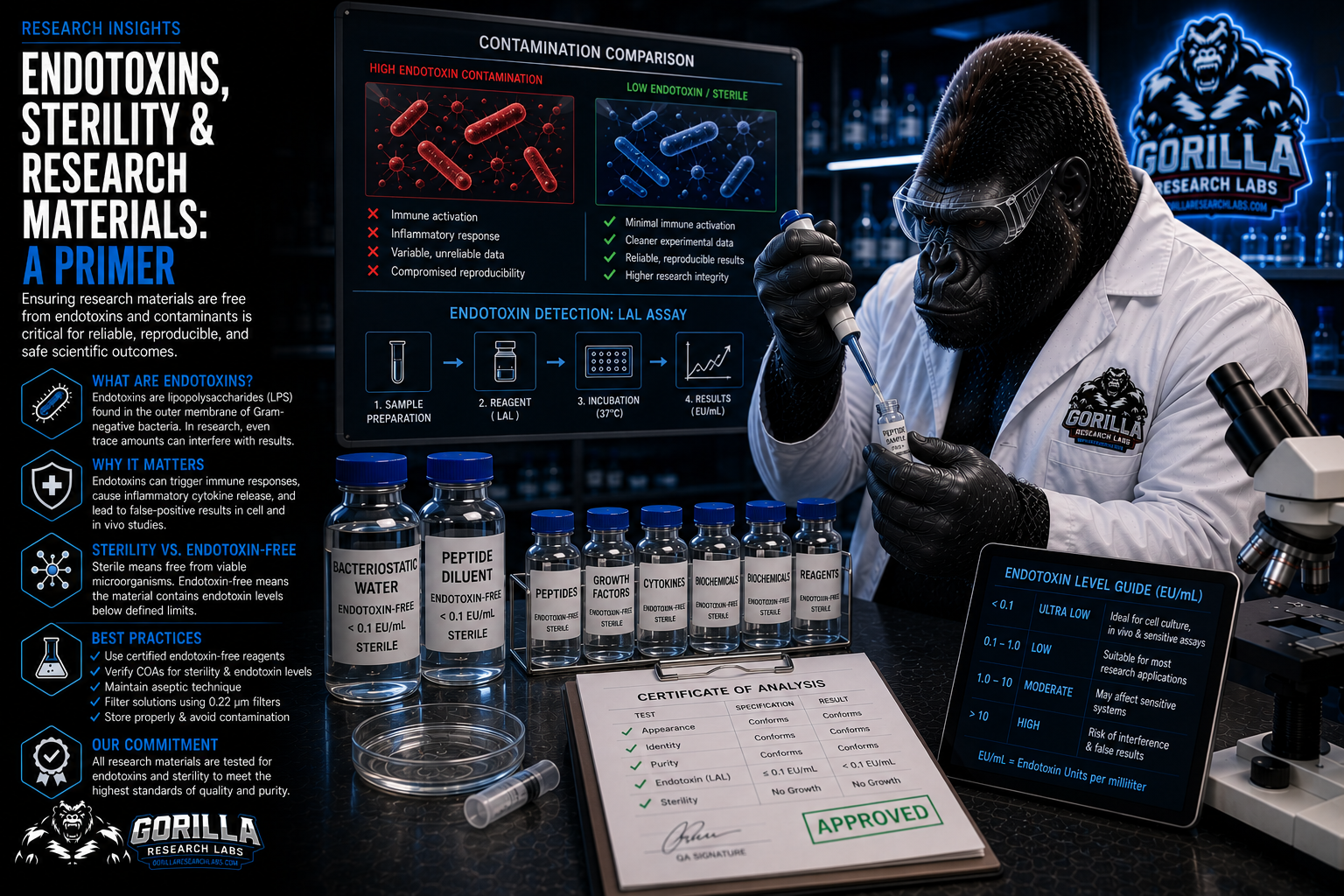
When researchers evaluate a material, chromatographic purity is only part of the picture. Endotoxin and sterility are separate quality attributes that may matter for some experimental systems, but they are not routinely present on every COA. If either attribute is required, verify that a suitable lot-specific method, result, units, and acceptance criterion are actually documented. Endotoxins are lipopolysaccharides (LPS) found in the outer membrane of Gram-negative bacteria. They are released when bacterial cells grow, die, or break apart, and they are remarkably stable — resistant to ordinary heat and many routine cleaning steps. Because they can persist even after the bacteria themselves are gone, a material can be free of living microbes yet still carry endotoxin. That distinction is central to understanding COA data.
Why low-endotoxin materials matter for cell-based research
In susceptible cell-based systems, endotoxin can stimulate biological responses and confound results. Sensitivity varies by model, matrix, concentration, and method, so “low endotoxin” is meaningful only when paired with a numerical limit and suitable assay. This is why endotoxin content is often reported and why "low-endotoxin" grades exist as a quality tier. Choosing a material with a documented, low endotoxin level helps researchers: • Reduce background stimulation in sensitive cell-culture assays • Improve run-to-run reproducibility across experiments • Isolate the variable they actually intend to study • Compare results more reliably against published literature
How labs test for endotoxins: the LAL concept
A widely referenced approach to endotoxin detection is the Limulus Amebocyte Lysate (LAL) assay. Conceptually, it uses a reagent derived from horseshoe-crab amebocytes to generate a response associated with bacterial endotoxin. Method suitability, interference controls, standards, and the sample matrix all affect interpretation. Results are typically expressed in endotoxin units per milligram (EU/mg) or per milliliter, giving a quantitative value that can be recorded on a COA. Common conceptual formats of the assay include: • Gel-clot — a qualitative or semi-quantitative readout based on clot formation • Turbidimetric — measures the cloudiness that develops as the reaction proceeds • Chromogenic — measures a color change proportional to endotoxin level Newer recombinant methods aim to reproduce this detection chemistry without relying on animal-derived reagent, reflecting an ongoing shift in analytical practice. In every case, the goal is the same: convert an invisible contaminant into a documented number a researcher can evaluate.
How sterility relates to material handling
Sterility is related but distinct. Endotoxin testing estimates a bacterial component, while a sterility test evaluates viable contamination under the conditions and limitations of that method. A sterility statement should be tied to the exact lot and evidence; it should not be inferred from clean appearance, purity, packaging, or a generic COA. A material can meet a sterility test and still contain endotoxin, so neither attribute can be inferred from the other. Handling can also introduce contamination after release. Relevant laboratory controls may include: • Working in appropriately clean environments and using aseptic technique • Minimizing exposure to open air and unnecessary handling • Following documented storage and reconstitution conditions • Tracking lot numbers and COA data for traceability
Reading these attributes on a COA
Taken together, identity, purity, endotoxin, and sterility results answer different questions; none substitutes for the others. When those attributes are required, look for the lot identifier, method, result, units, specification, date, and issuing laboratory. Documentation that is specific and lot-linked is more useful than vague “clean,” “sterile,” or “low-endotoxin” language. Understanding these quality attributes turns a COA from a formality into a genuine research tool — one that supports cleaner experiments and clearer data. For laboratory research use only. Not for human or animal consumption. This article is provided strictly for general educational purposes and makes no therapeutic, diagnostic, or performance claims of any kind.
References
- U.S. FDA — Q6A Specifications: Test Procedures and Acceptance Criteria
- U.S. FDA — Sterile Drug Products Produced by Aseptic Processing (Guidance)
- U.S. FDA — Guidance on Bacterial Endotoxins / Pyrogen Testing
- U.S. FDA — Research Use Only / Investigational Use Only products (Guidance)
Authoritative sources cited for research context. Research use only — not medical advice.