
Peptide Mass Spectrometry: How Labs Confirm a Sequence Matches Its Target
Purity Tells You "How Much." Identity Tells You "What."
HPLC and mass spectrometry answer related but narrower questions than the shorthand “purity and identity” suggests. HPLC can estimate the fraction of detected chromatographic signal assigned to a peak under a defined method. Mass spectrometry measures mass-to-charge signals that may support an identity assignment. Neither result alone proves full sequence, total-mass purity, sterility, or absence of every contaminant.
What Mass Spectrometry Measures
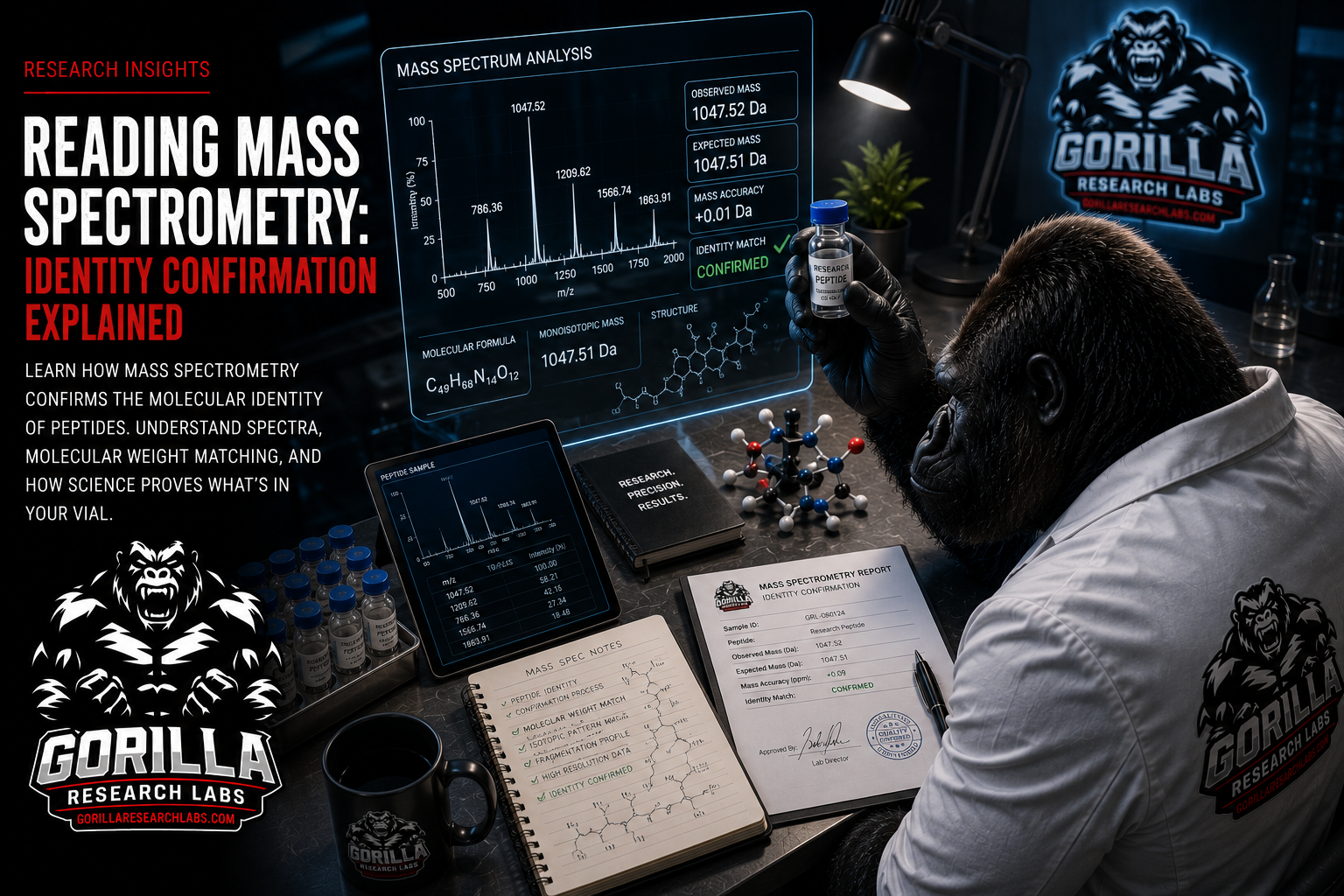
A mass spectrometer sorts ionized molecules by their mass-to-charge ratio (m/z). For peptide work, the most common approach couples liquid chromatography to electrospray ionization mass spectrometry (LC-MS or ESI-MS). The peptide is sprayed through a charged needle, which produces gas-phase ions carrying one or more charges. Because peptides readily pick up multiple protons, they typically show up as a family of related signals — for example [M+2H] 2+ and [M+3H] 3+ . Software deconvolutes those signals back into a single number: the measured molecular weight of the intact molecule.
Expected vs. Observed Mass
The heart of identity confirmation is a simple comparison between two numbers: • Expected (theoretical) mass — calculated directly from the amino acid sequence. Every residue contributes a known, fixed mass, so the target compound has one correct theoretical value. • Observed (measured) mass — the value the instrument actually records for the sample. Agreement between observed and expected mass can support a proposed identity when the ion form, adducts, charge-state assignment, calibration, mass accuracy, chemical form, and method tolerance are defined. A fixed ±1 Da rule is not universal. Isobaric sequences, modifications with similar net mass, adducts, and coexisting species can complicate interpretation; intact mass is evidence, not a unique fingerprint.
Why MS Complements HPLC
It is tempting to assume a high HPLC area percentage settles everything, but chromatographic response and identity are different properties. HPLC cannot definitively assign a peak without suitable reference and method evidence, and mass spectrometry does not automatically close every identity gap: • HPLC estimates relative detected peak area under the stated method. • MS measures mass-to-charge signals that may support a proposed molecular assignment. Used together, they provide complementary evidence, but method suitability, reference standards, original traces, integration, and orthogonal tests still matter. A COA should report only the methods actually performed for the identified lot.
Going Deeper: Sequence-Level Confirmation
Intact-mass measurement supports a total-mass assignment but does not establish residue order. Tandem mass spectrometry (MS/MS) can provide sequence-informative fragments when coverage and interpretation are adequate. Even then, the reported coverage, fragment assignments, tolerances, modifications, and ambiguities should be reviewed.
How This Supports Research Integrity
Documenting expected mass, observed ions, charge-state or deconvolution method, tolerances, and lot linkage makes an identity assessment traceable. It reduces uncertainty but does not, by itself, prove that the vial contents match every aspect of the label. Mass spectrometry is one part of an orthogonal characterization strategy.
Research-Use-Only Note
This article is provided strictly for educational and informational purposes about analytical laboratory methods. All products referenced are intended for laboratory and research use only. Nothing here is intended for human or animal consumption, and no diagnostic, therapeutic, or medical use is described, implied, or endorsed. Analytical parameters and tolerances vary by laboratory, instrument, and compound; always refer to the specific documentation supplied with a given research material.
References
- National Center for Biotechnology Information — Peptides (StatPearls)
- PubMed — Therapeutic peptides: current applications and future directions
- PMC — High-performance liquid chromatography (HPLC) principles and practice
- U.S. FDA — Analytical Procedures and Methods Validation for Drugs and Biologics
- PMC — Mass spectrometry-based proteomics and peptide identification
- U.S. FDA — Q6A Specifications: Test Procedures and Acceptance Criteria
Authoritative sources cited for research context. Research use only — not medical advice.