
Understanding Peptide Degradation: Oxidation, Hydrolysis, and Aggregation
Why Peptides Break Down
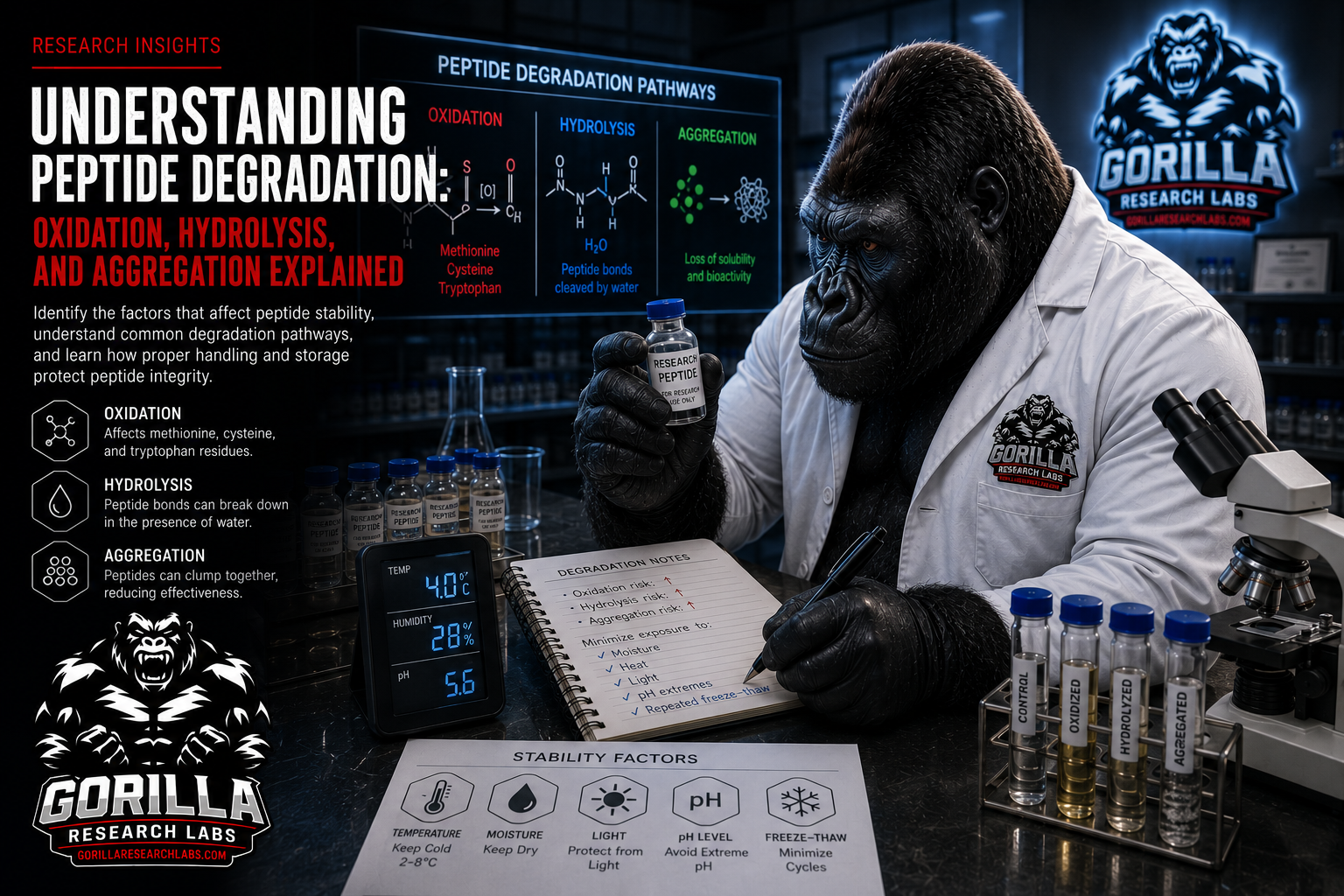
A peptide is a chain of amino acids held together by amide (peptide) bonds. That chain is remarkably specific, and that specificity is exactly what makes it chemically fragile. In a laboratory setting, a peptide sample is not a static object sitting inertly in a vial. It is a population of molecules that can slowly rearrange, cleave, oxidize, and clump over time. Understanding peptide degradation matters because degradation is the single largest reason a well-characterized reference material drifts away from its stated specification between synthesis and analysis. Degradation is not one process but several distinct chemical pathways, each driven by different residues, conditions, and reaction mechanisms. The four most relevant to a research bench are oxidation, hydrolysis, deamidation, and aggregation. Each leaves its own signature in analytical data, which is why a thorough characterization looks for all of them rather than reporting a single purity number in isolation.
Oxidation of Sensitive Residues
Oxidation targets the most electron-rich amino acid side chains. The usual suspects are: • Methionine — its sulfur atom readily forms methionine sulfoxide, adding roughly 16 mass units. • Cysteine — free thiols oxidize to disulfides or higher sulfur-oxygen species, scrambling the intended bonding pattern. • Tryptophan, tyrosine, and histidine — aromatic and imidazole rings are vulnerable, particularly under light exposure or in the presence of trace metals. Oxidation is accelerated by dissolved oxygen, transition-metal contaminants, and light. In analytical testing, an oxidized species typically appears as a new peak eluting slightly earlier in reversed-phase HPLC, paired with a characteristic mass shift (often +16 Da) in mass spectrometry. Sequences rich in methionine or with unprotected cysteine are inherently more prone to this pathway.
Hydrolysis and Backbone Cleavage
Hydrolysis is the cleavage of the peptide backbone itself, where water attacks an amide bond and splits one chain into two shorter fragments. It is strongly pH-dependent and is generally fastest at the extremes of acidity or alkalinity. Certain junctions are especially labile — aspartic acid residues, particularly Asp-Pro and Asp-Gly bonds, are classic hot spots for acid-catalyzed cleavage. Because hydrolysis produces genuinely smaller molecules, it shows up in mass spectrometry as fragments whose masses sum to the parent, and in chromatography as a cluster of lower-molecular-weight peaks.
Deamidation: A Quiet Sequence-Dependent Change
Deamidation converts asparagine or glutamine side chains into acidic residues, often by way of a cyclic succinimide intermediate. It adds roughly +1 mass unit and subtly shifts the molecule's charge and chromatographic behavior. The reason it deserves special attention is that it is highly sequence-dependent : an asparagine followed by a small, flexible residue such as glycine (an Asn-Gly motif) deamidates far faster than the same residue in a sterically crowded context. This is a prime example of why some sequences are intrinsically more fragile than others — the neighbors of a residue can matter as much as the residue itself.
Aggregation and Physical Instability
Aggregation is a physical rather than covalent pathway: individual peptide molecules associate into dimers, oligomers, and eventually visible or sub-visible particulates. Hydrophobic sequences and those prone to beta-sheet formation are the most aggregation-prone. Because aggregation removes intact monomer from solution without necessarily changing the mass of the monomer, it is best detected by size-exclusion chromatography, dynamic light scattering, or a simple visual and turbidity check, rather than by mass spectrometry alone.
How Degradation Surfaces in Analytical Testing
No single instrument catches every pathway, which is why a rigorous characterization layers several methods: • Reversed-phase HPLC — resolves oxidized, deamidated, and truncated species as distinct peaks and underpins the purity figure on a certificate of analysis. • Mass spectrometry — assigns the specific chemical change behind each peak via its mass shift (+16 for oxidation, +1 for deamidation, fragment masses for hydrolysis). • Size-exclusion chromatography and light scattering — quantify aggregation and high-molecular-weight species. Read together, these methods explain not just how much intact peptide is present but which pathway is eroding it. That is the deeper meaning of purity: a single number is only as trustworthy as the panel of tests standing behind it. For research teams, recognizing these signatures early is what separates a reproducible experiment from an ambiguous one, and it is the natural companion to sound handling and storage practices.
Research-Use-Only Note
For laboratory research use only. Not for human or animal consumption. Not a drug, supplement, or medical product. No statements here have been evaluated by the FDA, and nothing in this article is intended to diagnose, treat, cure, or prevent any disease. This content is provided solely to support the analytical and chemical characterization of research materials.
References
- National Center for Biotechnology Information — Peptides (StatPearls)
- PubMed — Therapeutic peptides: current applications and future directions
- PMC — High-performance liquid chromatography (HPLC) principles and practice
- U.S. FDA — Analytical Procedures and Methods Validation for Drugs and Biologics
- U.S. FDA — Q6A Specifications: Test Procedures and Acceptance Criteria
- PMC — Mass spectrometry-based proteomics and peptide identification
- PMC — Peptide and protein degradation: oxidation, hydrolysis and aggregation
Authoritative sources cited for research context. Research use only — not medical advice.