
HPLC Purity Testing Explained
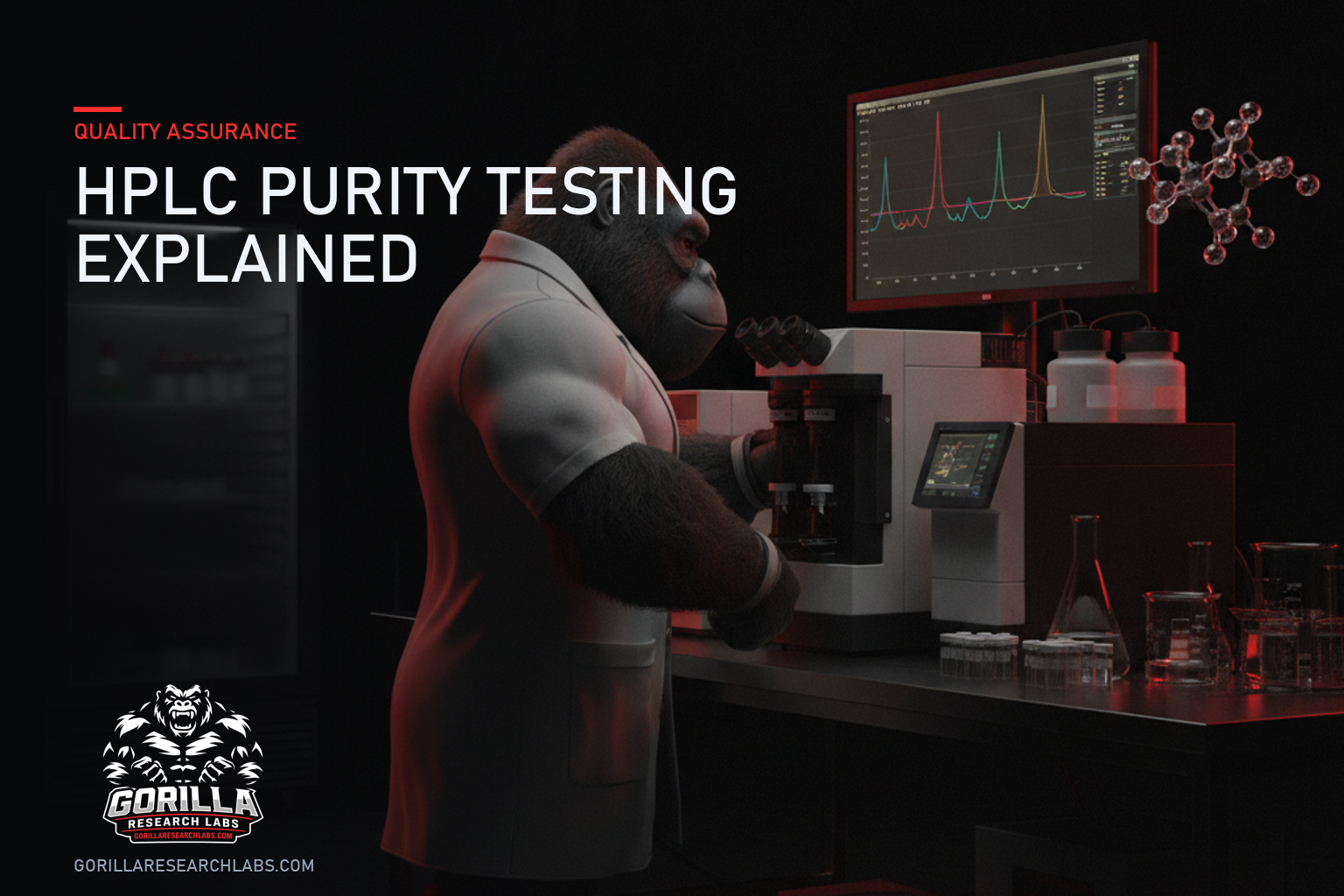
High-Performance Liquid Chromatography (HPLC) is one of the most widely used analytical techniques for evaluating the purity and composition of research compounds. Understanding how HPLC works helps researchers interpret Certificates of Analysis and compare reference materials with confidence.
What HPLC Measures
HPLC separates the individual components within a sample so their presence and relative amounts can be measured. A liquid sample is carried by a mobile phase through a column packed with a stationary phase. Different components travel through the column at different rates, emerging at different times. A detector records each component as a peak, producing a chromatogram that reflects the composition of the sample.
Reading a Chromatogram
On a chromatogram, the horizontal axis represents time and the vertical axis represents detector response. The main compound of interest typically appears as a large, well-defined peak. Smaller peaks may represent related substances or impurities. Two concepts are central to interpretation: • Retention time — the time a component takes to pass through the column, which helps confirm identity when compared against a reference. • Peak area — the area under each peak, used to estimate the relative proportion of each component in the sample.
How Purity Is Expressed
Purity is commonly reported as a percentage derived from the peak area of the target compound relative to the total detected peak area under a defined method. A result such as 99% area purity does not mean that 99% of the total vial mass is active material, nor does it establish identity, sterility, endotoxin status, or the absence of undetected substances. Treat any purity figure as product- and lot-specific, and verify it against the method, chromatogram, integration approach, and available batch documentation.
HPLC Alongside Other Methods
HPLC is often paired with complementary techniques. Mass spectrometry (including LC-MS) can support mass-based identity assessment, while other methods may be needed for sequence, water, counterions, residual solvents, aggregation, or microbiological attributes. Multiple suitable methods reduce uncertainty, but the scope and limitations of each result still matter.
Why Third-Party Testing Matters
Independent testing can add useful separation between seller and analyst, but “third-party” is not a substitute for method quality. Researchers should verify the laboratory identity, relevant accreditation or scope where claimed, sample and lot linkage, method parameters, acceptance criteria, and original analytical output. Third-party testing should be described as such only when independent records exist for the specific lot.
Research Use Disclaimer
This content is provided for educational and laboratory-reference purposes only. Products offered by Gorilla Research Labs are intended solely for laboratory research, analytical testing, and educational purposes. They are not intended for human or veterinary use, diagnosis, treatment, or prevention of any disease.
References
- PMC — High-performance liquid chromatography (HPLC) principles and practice
- U.S. FDA — Analytical Procedures and Methods Validation for Drugs and Biologics
- U.S. FDA — Q6A Specifications: Test Procedures and Acceptance Criteria
Authoritative sources cited for research context. Research use only — not medical advice.