
Understanding Lyophilization: Why Research Peptides Are Freeze-Dried
What Lyophilization Actually Is
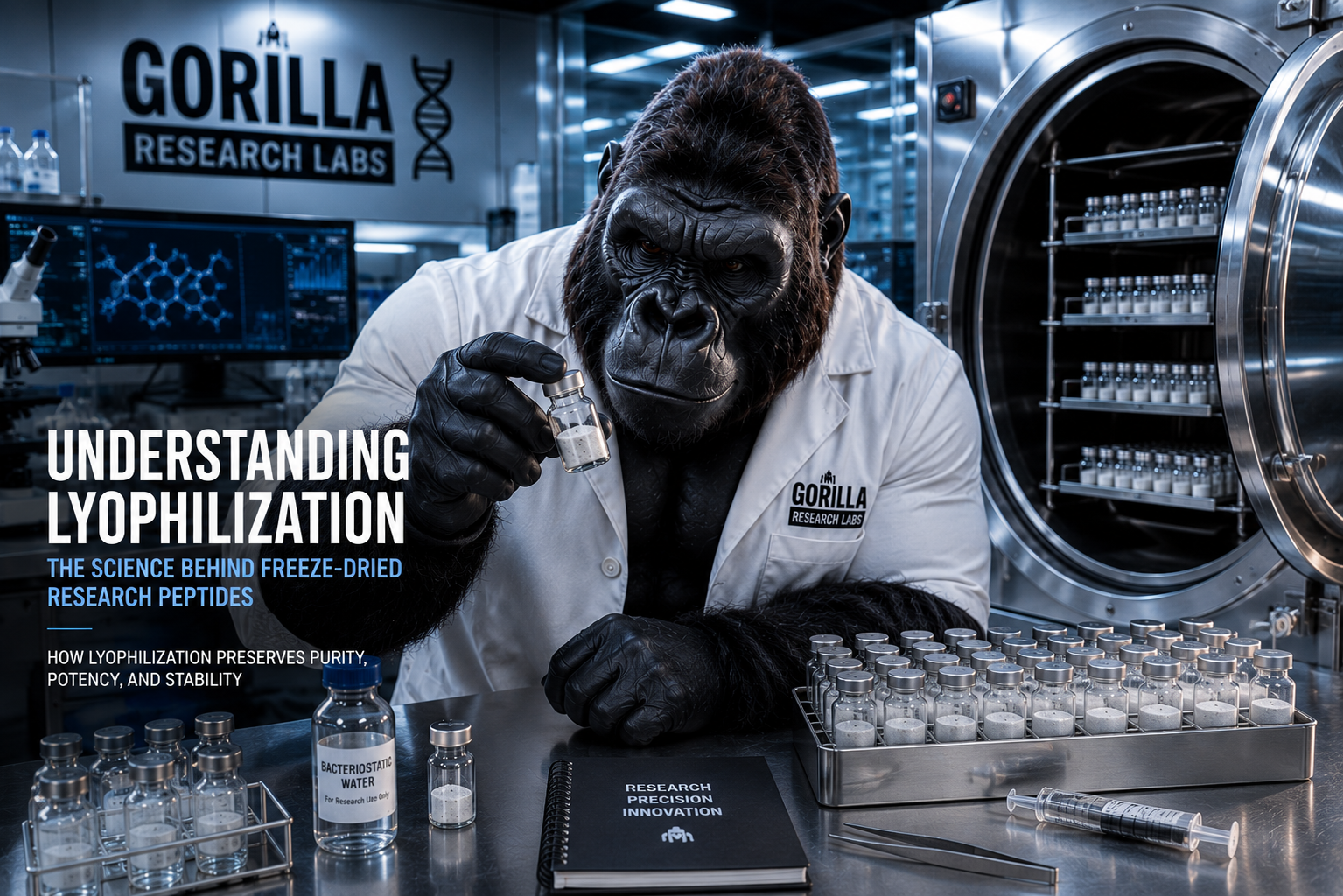
Many research peptides are supplied as a dry cake, film, or powder produced by lyophilization , better known as freeze-drying. The process can improve handling and stability by lowering residual water, but it does not establish a universal shelf life or prove that the material retained identity, purity, or activity. Lyophilization removes much of the water from a frozen formulation by sublimation under vacuum. The resulting solid contains the compound plus any salts, buffers, or bulking agents used in the formulation. Process development and analytical verification are needed to determine what attributes were retained.
The Science: Sublimation Under Vacuum
The core physical event in freeze-drying is sublimation , the transition of a substance from solid straight to gas, skipping the liquid state entirely. Water normally only does this under specific conditions of low pressure and low temperature, which is exactly the environment a lyophilizer creates. The process moves through three broad stages: • Freezing: The peptide solution is cooled well below its freezing point so that the water forms ice crystals and the dissolved compound is locked in place around them. • Primary drying: A deep vacuum is applied and a small amount of heat is added. Under this low pressure, the ice sublimes directly into vapor and is drawn off, leaving a porous solid behind. • Secondary drying: The temperature is raised slightly to coax out the last traces of water molecules bound to the compound, driving residual moisture down to very low levels. Lyophilization can be useful for heat-sensitive materials, but freezing, interfaces, residual moisture, and drying conditions can also cause stress. Suitability must be established for the specific formulation.
Why Removing Water Improves Stability
Water can enable hydrolysis and microbial growth, while oxidation, aggregation, deamidation, and other changes also depend on sequence, oxygen, light, pH, excipients, temperature, and packaging. Lower residual moisture can slow some pathways but does not stop all degradation. A lyophilized material may be more stable than a solution under defined conditions. The magnitude and duration must come from product-specific stability evidence, not from dry appearance or a generic cold-storage assumption.
Reading the Cake or Powder
The physical appearance of the dried product, often called the cake , carries useful information. A well-formed lyophilization typically leaves a uniform, intact disc or a consistent fine powder. That structure reflects a controlled freeze and a clean sublimation. • A clean, uniform cake records appearance only; it does not prove the process met chemical or microbiological specifications. • A collapsed, shrunken, or melted-looking mass can indicate that drying conditions were not ideal or that the vial saw heat or moisture. • A very thin film or barely visible residue is normal for compounds present in small microgram or low-milligram quantities and does not by itself signal a problem. Appearance is an observational cue, not a substitute for analytical documentation. The definitive picture of identity and purity comes from testing paperwork such as a Certificate of Analysis, which addresses questions the cake alone cannot answer.
Why It Is the Standard Form
Freeze-drying is a formulation and manufacturing tool, not a quality conclusion. Its value is established by process controls and data showing that the packaged material meets defined attributes through a stated storage interval. The cake at the bottom of a vial is evidence of physical form only. Identity, purity, residual water, potency where relevant, microbiological attributes, and stability each require appropriate documentation or testing. Research-use-only note: This article is provided for laboratory research use only and is intended purely for educational purposes. The products discussed are not for human or animal consumption and are not drugs, supplements, or medical products. No statements here have been evaluated by the FDA, and nothing in this article is intended to diagnose, treat, cure, or prevent any disease, or to describe the administration of any compound to humans or animals.
References
- National Center for Biotechnology Information — Peptides (StatPearls)
- PubMed — Therapeutic peptides: current applications and future directions
- PMC — Lyophilization/freeze-drying of proteins and peptides
Authoritative sources cited for research context. Research use only — not medical advice.