
Bacteriostatic Water vs Sterile Water: Research Diluent Fundamentals
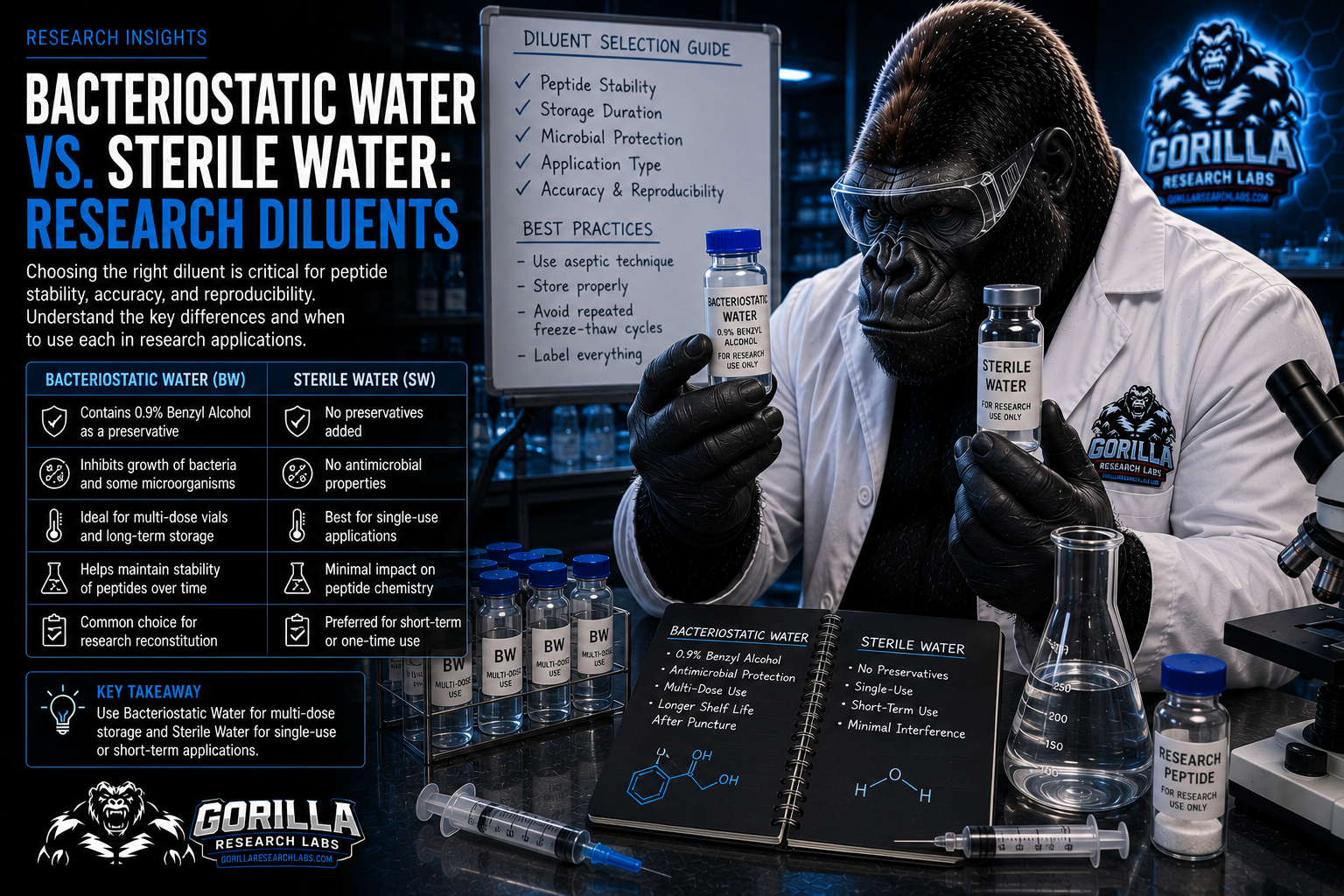
Two Waters, One Big Difference
When a lyophilized research compound is prepared for a solution-based analytical method, diluent choice can affect solubility, stability, and measurement interference. Bacteriostatic Water for Injection and Sterile Water for Injection are regulated product names with label-defined formulations; generic research solvents should not be assumed to meet those same specifications merely because similar words appear on a listing.
What Makes Water "Bacteriostatic"
For a labeled regulated product, the official labeling defines whether it is sterile, non-pyrogenic, preservative-free, or formulated with a specified benzyl-alcohol concentration. Those attributes are test- and product-specific. The DailyMed labeling for Bacteriostatic Water for Injection, USP is an authoritative example; it is not evidence that every research-use water has the same formulation or quality status. Benzyl alcohol (C₆H₅CH₂OH) is an aromatic alcohol. Its benzene ring makes the molecule partially lipophilic, so it partitions into and disrupts lipid membranes. In practical terms, it interferes with the integrity of microbial cell membranes enough to inhibit replication . The term "bacteriostatic" is precise: the additive holds microbial growth in stasis rather than sterilizing the solution outright. It is static, not cidal.
Why the Preservative Matters for Solution Stability
A preservative can inhibit some microbial growth, but it does not sterilize a contaminated solution or establish the chemical stability of a dissolved compound. Label-defined in-use directions for a regulated water product cannot be transferred to an arbitrary reconstituted research stock. For repeated laboratory sampling, the usable interval must be supported for the specific compound, concentration, container, access pattern, storage condition, and analytical acceptance criteria. Preservative status is only one variable.
When the Chemistry Argues Against Benzyl Alcohol
The preservative is not universally ideal, and this is where diluent selection becomes a genuine chemistry question rather than a default. Two considerations recur: • Compound compatibility. Benzyl alcohol is a small, reactive organic molecule. Certain sensitive compounds, particularly some larger peptides or proteins, can show interactions with the additive that affect the stability or integrity of the dissolved material over time. • Analytical interference. Because benzyl alcohol has a distinct aromatic UV absorbance, it can complicate spectroscopic or chromatographic characterization of the compound in solution. A blank solvent such as sterile water avoids introducing that background signal. This is why some protocols deliberately choose the plain solvent, or an acidified aqueous diluent, when the goal is a clean matrix for analysis or maximum compatibility with a delicate molecule, and reserve bacteriostatic water for cases where an extended in-use window is the priority.
Choosing a Diluent: A Materials Checklist
• Solubility of the compound in the aqueous base — both share the same water starting point, so this is usually equivalent. • Required in-use window — use a validated stability and contamination-control plan; preservative presence alone does not define the interval. • Analytical plans — if UV or chromatographic characterization is intended, a solvent free of aromatic additives keeps the baseline clean. • Additive compatibility — confirm the compound is not known to interact with benzyl alcohol before selecting a preserved diluent. • Storage conditions — temperature and light exposure govern the stability of any reconstituted solution regardless of which diluent is used.
The Bottom Line
Preservative-free and benzyl-alcohol-containing waters can behave differently in an analytical method, but neither is a universal neutral blank or stability solution. Verify the exact formulation and quality claims on the product label, then select a diluent from compound-specific solubility, compatibility, interference, and stability evidence. Research-use-only note: This article is provided strictly for educational and material-science reference purposes. It describes the chemistry of laboratory diluents in research contexts only. Nothing here is intended as guidance for administration, dosing, human or animal use, or any therapeutic or medical application. All products are sold for in-vitro laboratory research use only.
References
- National Center for Biotechnology Information — Peptides (StatPearls)
- PubMed — Therapeutic peptides: current applications and future directions
- PMC — Lyophilization/freeze-drying of proteins and peptides
- PMC — Stability and handling of reconstituted peptide solutions
- NCBI Bookshelf — Benzyl Alcohol (bacteriostatic preservative)
- U.S. FDA — Sterile Drug Products Produced by Aseptic Processing (Guidance)
- U.S. FDA — Research Use Only / Investigational Use Only products (Guidance)
Authoritative sources cited for research context. Research use only — not medical advice.