
The Science of Peptide Reconstitution: How Lyophilized Compounds Return to Solution
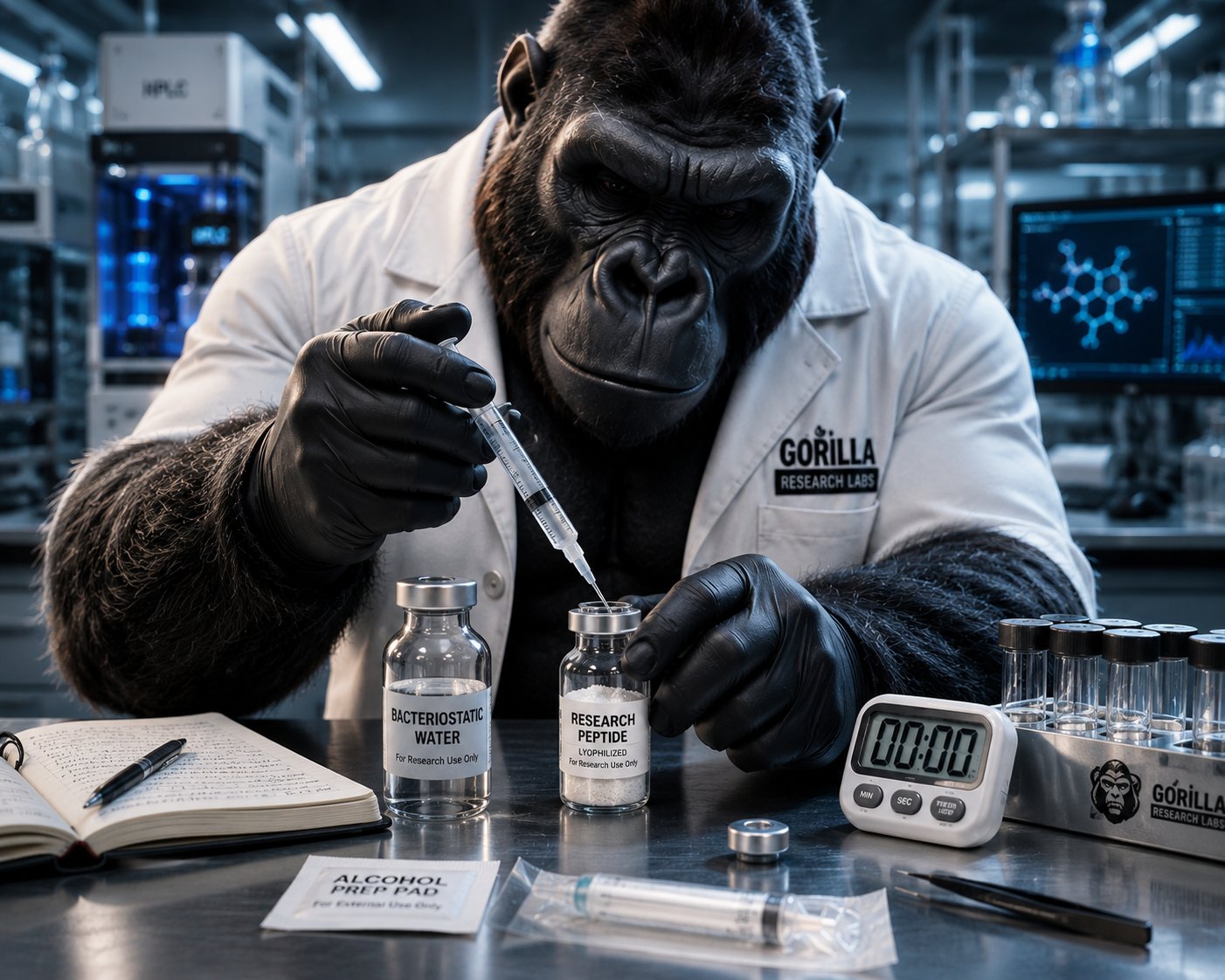
What Lyophilization Actually Leaves Behind
When a research peptide is freeze-dried, lyophilization removes much of the water by sublimation under vacuum. What remains may be a porous cake, film, or powder containing the peptide plus any excipients or salts used in the formulation. Lower residual water can improve stability for some materials, but appearance and lyophilization alone do not establish identity, purity, shelf life, or solution stability. Reconstitution is the documented addition of a compatible solvent for a defined analytical method.
Solvent Selection: The Research Diluent Concept
Two diluent labels commonly discussed are sterile water and bacteriostatic water. Those names are not interchangeable with generic purified water, and their attributes must be verified on the specific product label: • Sterile is a product claim supported by an appropriate process and test strategy; it should not be inferred from appearance. • Bacteriostatic indicates a preservative intended to inhibit microbial growth. It does not mean a contaminated solution is sterilized or that a dissolved compound has a validated multi-use lifetime. Solvent choice matters chemically because peptides differ in solubility. Some are freely water-soluble; others are more amenable to a mildly acidic or basic diluent because pH shifts the net charge on the molecule and reduces the tendency of chains to associate with one another. The governing principle is that the diluent should suit the peptide's own chemistry, and that any handling decision here is a bench question about solubility and stability, not a use question.
Why Solvent Runs Down the Vial Wall
Addition rate, mixing, and contact with air-liquid interfaces can affect some peptide formulations. Use the product-specific or validated method rather than assuming that one wall-running technique is required for every sequence and container.
Dissolution Versus Aggregation
Dissolution and aggregation depend on sequence, concentration, pH, ionic strength, solvent, excipients, temperature, surfaces, and mixing. Cloudiness or particulates can signal a problem, but a clear solution does not prove identity, concentration, or lack of aggregates. Define acceptance criteria in the method and investigate unexpected appearance rather than relying on a universal visual rule.
Gentle Swirling, Not Shaking
Mixing intensity should follow the validated method. Gentle mixing is often selected for aggregation-prone materials, while other formulations may require defined agitation. Do not assume “never shake,” a fixed dissolution time, or visual clarity is a universal specification.
Why Technique Drives Experimental Consistency
The reason any of this belongs in a lab notebook is reproducibility. Two vials of identical material, reconstituted with different care, can yield solutions that behave differently in downstream work: different clarity, different effective concentration of intact chains in solution, different stability over the storage window. Standardizing the diluent, the addition rate, and the mixing method removes a hidden variable from experimental design, so that observed results reflect the study, not the handling. • Match the diluent to the peptide's known solubility and pH sensitivity. • Add solvent slowly down the vial wall to limit shear and foaming. • Use the mixing mode and time defined by the validated method. • Record diluent, ratio, and method so the procedure is repeatable. For laboratory research use only. Not for human or animal consumption. This article is educational information about the physical chemistry of laboratory materials and does not describe or imply any form of administration or use in living subjects.
References
- National Center for Biotechnology Information — Peptides (StatPearls)
- PubMed — Therapeutic peptides: current applications and future directions
- PMC — Lyophilization/freeze-drying of proteins and peptides
- PMC — Stability and handling of reconstituted peptide solutions
- NCBI Bookshelf — Benzyl Alcohol (bacteriostatic preservative)
- U.S. FDA — Sterile Drug Products Produced by Aseptic Processing (Guidance)
Authoritative sources cited for research context. Research use only — not medical advice.