
Sterile Technique and Contamination Control in Peptide Research
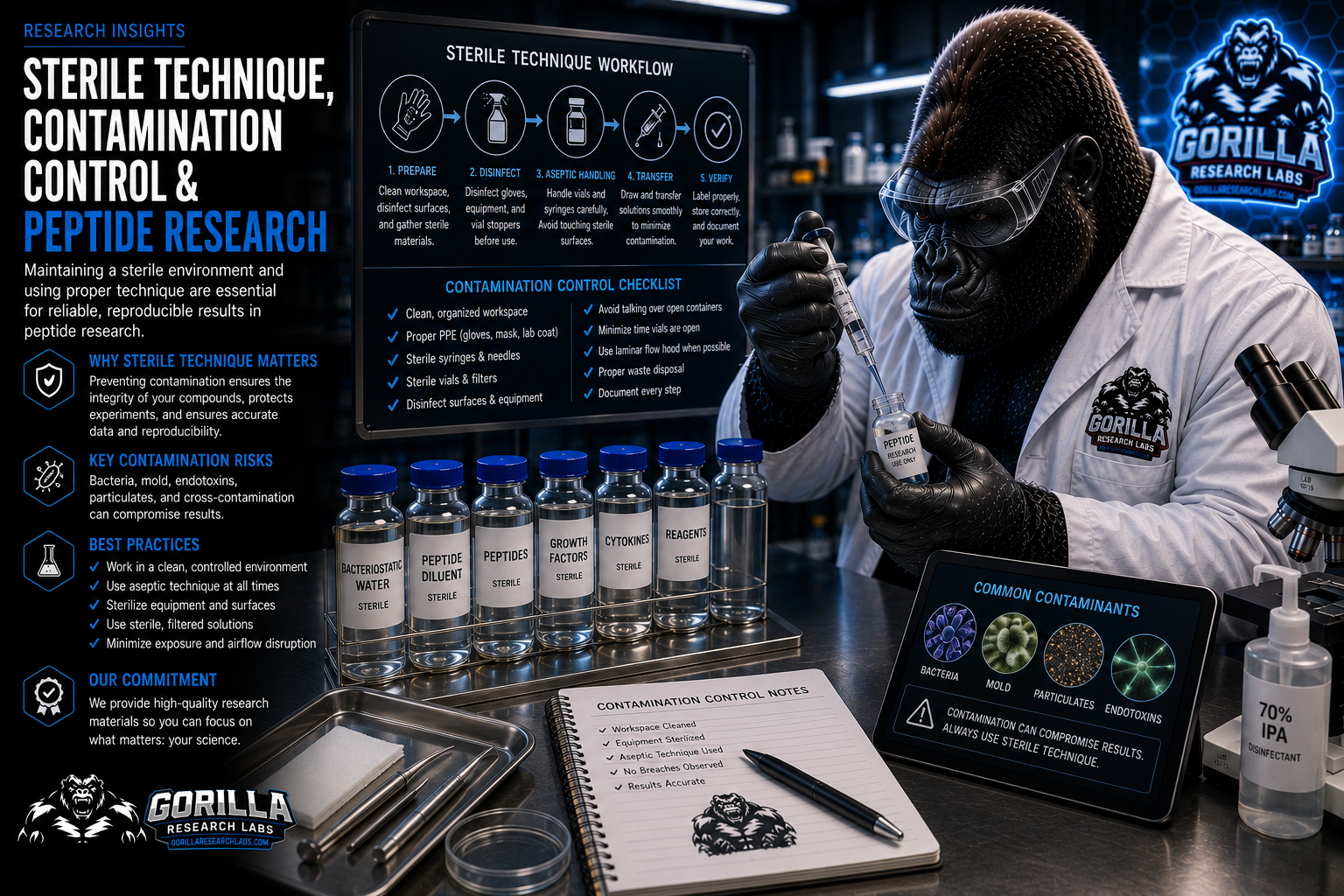
In peptide research, the reliability of your results depends on more than the quality of the compound in the vial. It depends on how cleanly that vial is handled at the bench. Sterile technique in the laboratory is not a formality. It is a direct safeguard for experimental validity. A single lapse in aseptic handling can introduce microbial or particulate contamination that silently confounds an assay, degrades a stored solution, or renders a data set unusable. This guide covers the core best practices for keeping research vials clean and your data trustworthy.
Why Contamination Control Protects Your Data
Contamination is rarely visible until it has already compromised an experiment. Microbial growth in a reconstituted stock can alter concentration over time, introduce enzymatic activity that cleaves the target peptide, and produce turbidity or byproducts that interfere with spectroscopic and chromatographic readings. Even without visible growth, particulates and airborne contaminants introduce variables you did not design into your study. The consequence is a loss of experimental validity. When a result cannot be reproduced, contamination is one of the most common and most preventable culprits. Treating sterile technique as a standard part of laboratory hygiene means your measurements reflect the compound you are studying, not an uncontrolled biological or chemical artifact.
Establishing a Clean Work Area
Contamination control begins before any vial is opened. A clean, dedicated work area limits the number of variables that can reach an open container. • Clear the bench of clutter and wipe the surface with an appropriate laboratory disinfectant, such as 70% isopropyl alcohol, and allow it to air dry. • Where available, perform open-container work in a laminar flow hood or biosafety cabinet to reduce airborne particulates. • Keep the work zone free of paperwork, food-adjacent items, and unnecessary equipment that can shed particles. • Wear clean gloves and a lab coat, and change gloves if they contact a non-sterile surface. • Minimize air currents and foot traffic near open vials, since disturbed air carries contaminants.
Aseptic Handling of Research Vials
The vial stopper is the primary entry point for contamination, so it deserves deliberate attention. Before puncturing any stopper, wipe it with a fresh alcohol swab and let it dry fully. A wet surface can carry contaminants along the needle track, and the brief drying time allows the disinfectant to work. • Wipe each stopper with a fresh, single-use alcohol swab every time, not just on first access. • Never touch the cleaned stopper surface, the needle, or the syringe tip with bare hands or non-sterile objects. • Use a new, sterile needle and syringe for each vial and each withdrawal to prevent cross-contamination between containers. • Keep vials capped and upright whenever they are not actively in use. • Inspect every vial before use and discard any showing cloudiness, discoloration, or particulates.
Protecting Stock Solutions from Needle Contamination
Reconstituted and stock solutions are especially vulnerable because they are accessed repeatedly over time. Each entry into the vial is an opportunity to introduce contaminants that then have a solution to grow in. The most common failure is reusing a needle that has already contacted another surface. • Use a fresh sterile needle for every entry into a stock vial, never a previously used one. • Avoid letting the needle touch the outside of the vial, the bench, or gloves before it enters the stopper. • Do not return withdrawn liquid to a shared stock; treat any drawn volume as separated from the source. • Label reconstituted solutions with the preparation date and store them under the conditions your protocol specifies. • Track how many times a vial has been accessed, and retire solutions according to your stability data rather than pushing them past their reliable window.
Building Sterile Technique into Routine Practice
Consistency is what makes contamination control effective. Sporadic care leaves gaps, and contamination exploits gaps. Document your handling steps in a standard operating procedure so that every researcher follows the same clean-area setup, stopper-wiping, and single-use needle practice. Periodically review technique, because habits drift over time and a quick refresh keeps the whole lab aligned. When sterile technique is treated as a baseline expectation rather than an occasional extra step, the payoff is cleaner data, fewer failed runs, and results you can defend and reproduce. That is the real purpose of laboratory hygiene: protecting the integrity of the science. Research-use-only note: The information above concerns laboratory hygiene and data integrity practices only. All products are sold strictly for laboratory research use and are not for human or animal consumption. Nothing here describes or endorses any human or animal use, administration, or therapeutic application.
References
- National Center for Biotechnology Information — Peptides (StatPearls)
- PubMed — Therapeutic peptides: current applications and future directions
- PMC — Stability and handling of reconstituted peptide solutions
- U.S. FDA — Sterile Drug Products Produced by Aseptic Processing (Guidance)
Authoritative sources cited for research context. Research use only — not medical advice.