
Storage and Cold-Chain Handling for Research Peptides
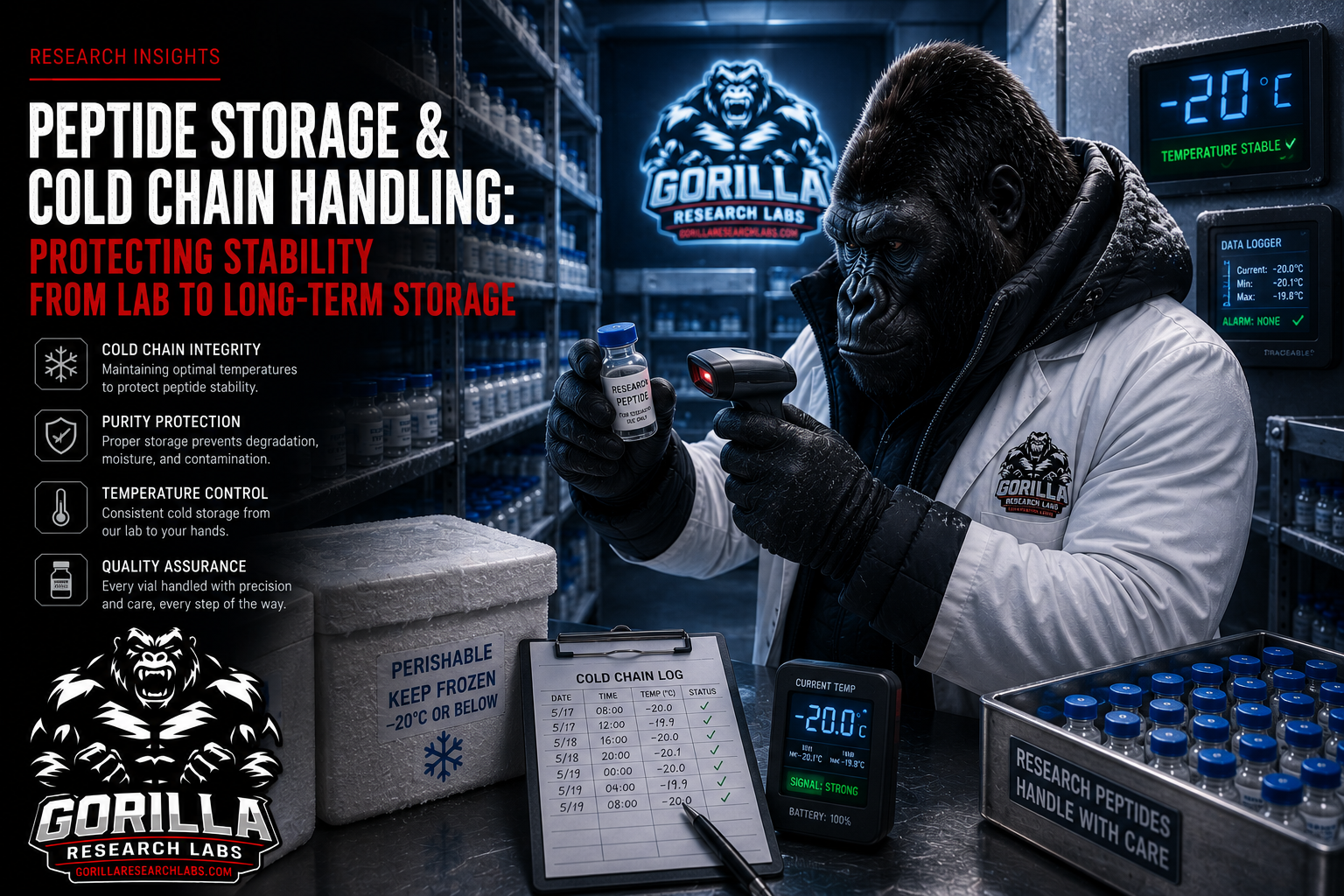
Proper storage is one of the most underappreciated variables in any research program that works with peptides. A compound can be characterized to the highest purity standard, yet still fail to perform as a reference material if it has been mishandled between the freezer and the bench. This guide covers general laboratory best practices for storing and transporting lyophilized and reconstituted research peptides. It is written strictly as a material-handling reference for laboratory professionals and does not address any use of these compounds.
Lyophilized vs. Reconstituted: Two Different Storage Problems
Many peptides are supplied in a lyophilized (freeze-dried) form because lowering residual water can slow some degradation pathways. That does not establish a universal shelf life: sequence, formulation, residual moisture, oxygen, light, container closure, and temperature all matter. A solution may have a different stability profile, but its usable interval cannot be assumed to be “days or weeks” without compound- and matrix-specific data. Temperature is one part of a storage decision, not a universal three-tier schedule: • Room-temperature, refrigerated, and frozen conditions can each be appropriate for particular materials when supported by the label or stability study. • Freezing is not automatically protective. It can cause phase separation, concentration gradients, precipitation, or container stress in some formulations. • A temperature without a time limit is incomplete. Record the validated condition, allowable excursion, and hold time together. Defer to product-specific labeling and available stability data. A COA may report analytical results without containing validated storage data, so do not treat the presence of a COA as proof of a shelf life.
Why Freeze-Thaw Cycles Degrade Peptides
Freeze-thaw cycling can change local solute concentration, pH, interfaces, and physical state, which may promote aggregation or precipitation for some sequences and formulations. The magnitude is material-specific and should not be inferred from appearance or a fixed number of cycles. If a validated method calls for frozen aliquots, subdivision can reduce repeated handling. Record compound identity, lot, solvent, concentration, preparation date, container, storage condition, and cycle count; aliquoting is a control strategy, not evidence that the material remained stable.
Protecting Against Light and Moisture
Two ambient factors deserve particular attention. Light, especially UV, can drive photodegradation in sequences containing sensitive residues such as tryptophan, tyrosine, and methionine. Storing vials in amber containers, or simply keeping them in the dark inside a box or drawer, removes this variable at essentially no cost. Moisture can be important for lyophilized material, although hygroscopicity varies with peptide, salts, and excipients. When required by the labeled procedure, allowing a sealed cold container to equilibrate before opening can reduce condensation. Laboratories should define this step in an SOP rather than assume it applies identically to every vial.
The Role of Desiccants
Desiccant packs can maintain a lower-humidity secondary environment when they are compatible with the packaging and monitored under an SOP. They do not establish or extend a labeled expiry period; usable life still requires stability evidence for the packaged material.
Cold-Chain Logistics During Shipping
Shipping must preserve the transport condition specified for the material. If a cold chain is required, possible controls include: • Insulated packaging with gel packs or dry ice appropriate to the required temperature tier. • Sufficient coolant mass to cover realistic transit time plus a safety margin for delays. • Sealed, moisture-protected inner packaging so that condensation from melting coolant never reaches the vials. • Optional temperature-indicator strips or data loggers to document that the cold chain held during transit. On receipt, compare the shipment against its stated transport requirements and quarantine unexplained excursions under the laboratory's quality procedure. Coolant appearance alone does not prove that the required temperature range was maintained.
Building a Storage Routine
Good storage practice is a documented chain of evidence: identify the exact material and lot, follow its labeled condition, record receipt and excursions, use a validated solution hold time, and preserve traceability through any subdivision. Generic habits are useful only when they are compatible with the product-specific data. Research-use-only note: All content above is provided solely as general laboratory material-handling information for research and educational purposes. The compounds discussed are intended for in-vitro laboratory research use only. Nothing here constitutes guidance for any human or animal use, and no dosing, administration, therapeutic, or medical application is described or implied.
References
- National Center for Biotechnology Information — Peptides (StatPearls)
- PubMed — Therapeutic peptides: current applications and future directions
- PMC — Lyophilization/freeze-drying of proteins and peptides
- PMC — Stability and handling of reconstituted peptide solutions
Authoritative sources cited for research context. Research use only — not medical advice.