
Solid-Phase Peptide Synthesis Explained for Researchers
What Solid-Phase Peptide Synthesis Actually Is
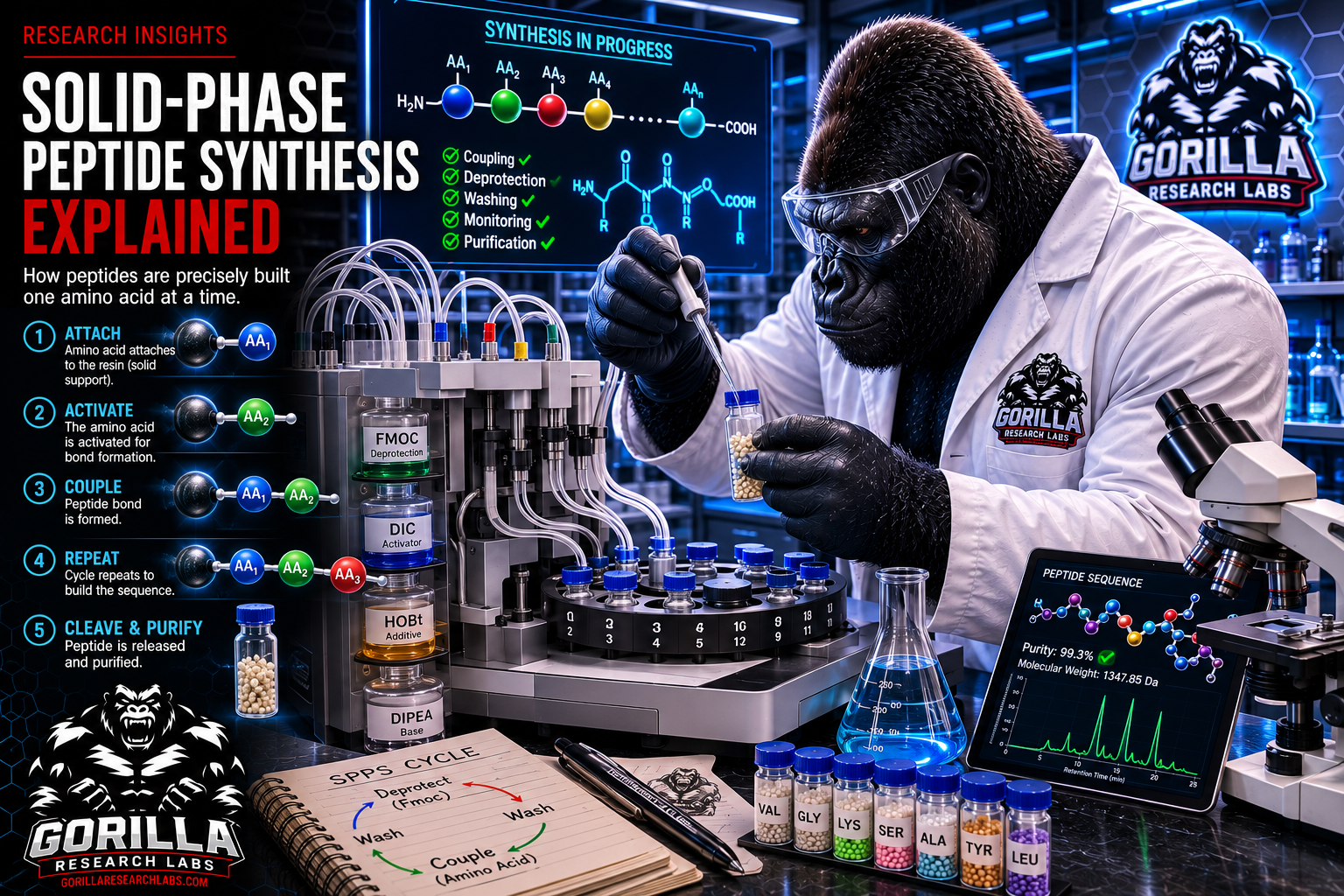
Almost every research peptide on the market today is built using solid-phase peptide synthesis, or SPPS. The core idea, first introduced by Robert Bruce Merrifield in the 1960s, is elegant: instead of assembling a peptide chain floating freely in solution, you anchor the growing chain to a solid support and build it one amino acid at a time. That anchoring is what makes the whole process practical, repeatable, and scalable for a laboratory setting. The solid support is a tiny insoluble bead called a resin. The first amino acid of the target sequence is chemically attached to this resin, and every subsequent residue is added on top of it. Because the chain never leaves the bead until the very end, excess reagents and byproducts can simply be washed away between each step. This washing-based purification at every stage is the defining advantage of SPPS over older solution-phase methods.
Building the Chain One Residue at a Time
SPPS is a repeating cycle. Each full cycle adds exactly one amino acid to the chain, and the sequence is built from the C-terminus toward the N-terminus. A single cycle involves two chemically distinct operations that alternate over and over: • Deprotection: Each incoming amino acid arrives with its reactive N-terminal group temporarily masked by a protecting group so it cannot react prematurely. Deprotection removes that mask, exposing the site where the next residue will attach. In modern Fmoc-based chemistry, this is typically done with a mild base treatment. • Coupling: The next protected amino acid is activated and introduced. It forms a new peptide bond with the freshly exposed N-terminus, extending the chain by one unit. Coupling reagents drive this bond formation efficiently and are used in excess to push the reaction toward completion. After each deprotection and each coupling, the resin is washed thoroughly to remove leftover reagents and soluble byproducts. The cycle then repeats for the next residue. A 30-residue peptide therefore involves roughly 30 rounds of this deprotect-couple-wash sequence.
Cleavage and Release
Once the full sequence has been assembled, the finished peptide is still bolted to the resin and still carries the side-chain protecting groups that kept the various amino acids from interfering with one another during synthesis. Cleavage is the final chemical step that accomplishes two things at once: it detaches the peptide from the resin and strips away the remaining side-chain protecting groups. In Fmoc chemistry this is commonly done with a trifluoroacetic acid cocktail. The result is a crude peptide that is then typically purified, most often by reversed-phase HPLC, and characterized by mass spectrometry.
Why the Synthesis Method Shapes Final Purity
No coupling step is ever perfectly 100 percent efficient. If a small fraction of chains fail to couple in a given cycle, those chains can either stop growing or resume in the next cycle, producing closely related impurities. Because these effects compound across every cycle, longer sequences are inherently harder to make cleanly than short ones. The characteristic impurity families that arise from SPPS include: • Deletion sequences: chains missing one or more residues because a coupling step did not go to completion. • Truncated sequences: chains that stopped growing partway through. • Incomplete deprotection or side reactions: residual protecting groups or modified residues left behind by imperfect chemistry. • Aggregation-related failures: difficult "hard-coupling" regions where the growing chain folds on itself and resists reagent access. This is precisely why synthesis method, sequence length, and post-synthesis purification all leave a fingerprint on the final material. Two batches of the same nominal peptide can differ in their impurity profiles depending on how carefully each cycle was driven to completion and how aggressively the crude product was purified afterward. Understanding SPPS is what makes an analytical Certificate of Analysis meaningful: the purity percentage and the impurity peaks reported on a COA are the direct downstream signature of the manufacturing steps described above. The synthesis explains the numbers, and the numbers are what a researcher evaluates when assessing material for laboratory work.
The Takeaway for Researchers
SPPS is not a black box. It is a disciplined, cyclical chemistry in which a peptide is grown residue by residue on a bead, released at the end, and purified. Every design choice along that path, from protecting-group strategy to coupling efficiency to final purification, propagates into the purity and impurity data that ultimately describe the compound. Knowing how the molecule was built gives researchers a clearer lens for interpreting the analytical documentation that accompanies it. Research-use-only note: All content on the Gorilla Research Labs blog is provided strictly for educational and informational purposes relating to laboratory research. The compounds discussed are intended for research use only. Nothing here constitutes medical, therapeutic, dosing, or administration guidance, and none of these materials are intended for human or animal use.
References
- National Center for Biotechnology Information — Peptides (StatPearls)
- PubMed — Therapeutic peptides: current applications and future directions
- PMC — Solid-phase peptide synthesis: an overview
- U.S. FDA — Q6A Specifications: Test Procedures and Acceptance Criteria
- PMC — High-performance liquid chromatography (HPLC) principles and practice
Authoritative sources cited for research context. Research use only — not medical advice.