
Amino Acids to Sequence: The Building Blocks of Research Peptides
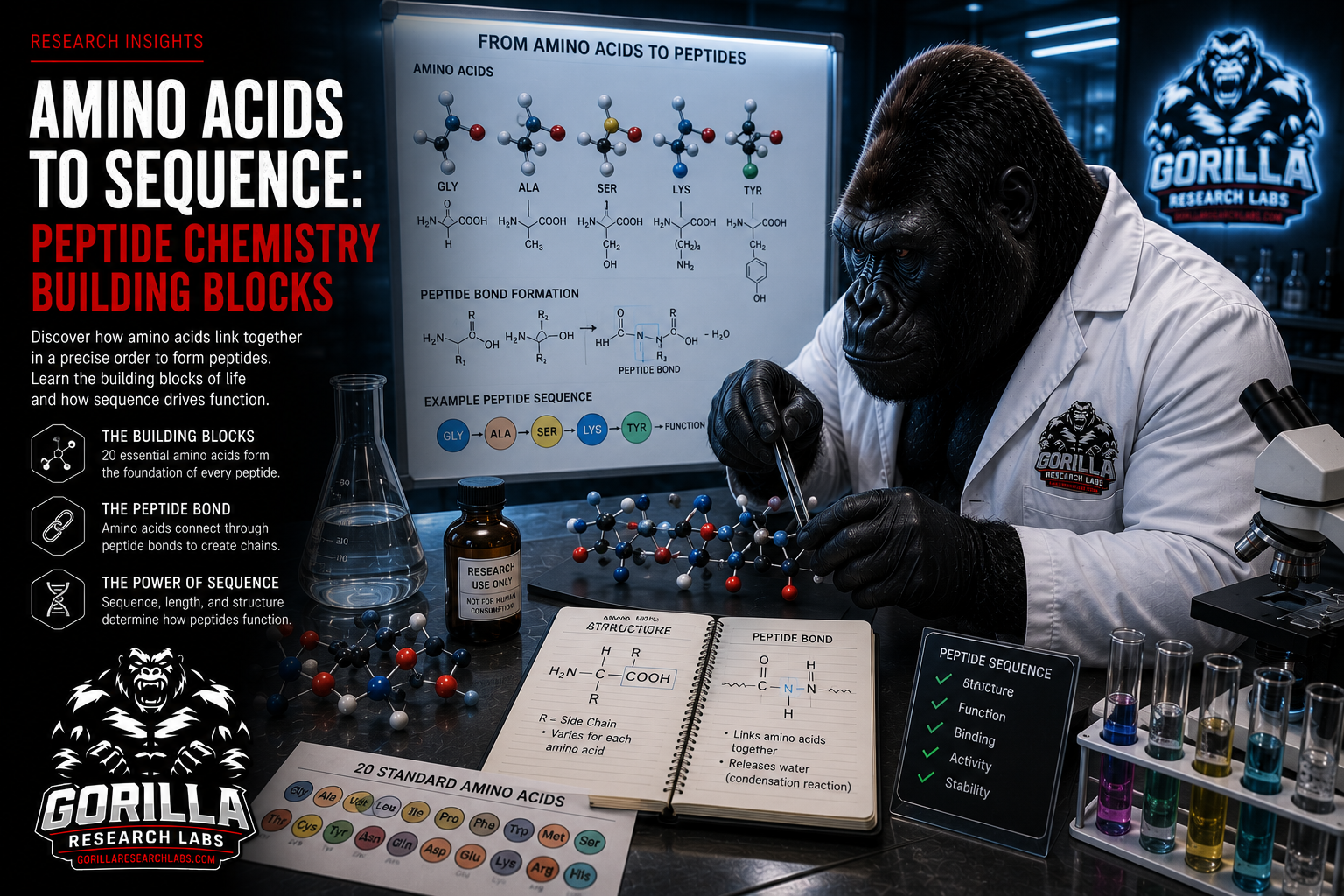
If you have read a high-level overview of what research peptides are, you know they sit somewhere between a single amino acid and a full protein. But that definition raises the real question: what actually makes one peptide different from another? The answer lives in peptide chemistry — specifically, in the order and identity of the amino acids that compose each molecule. This primer fills that chemistry gap, working from the smallest building block up to a written sequence.
Amino Acids: The Alphabet of Peptides
Every peptide is built from amino acids. Each amino acid shares a common architecture: a central carbon atom bonded to an amino group (-NH2), a carboxyl group (-COOH), a hydrogen atom, and a variable side chain often written as "R." That side chain is what distinguishes one amino acid from another. There are twenty standard amino acids commonly referenced in peptide science, and their side chains span a wide range of chemical personalities. • Nonpolar / hydrophobic side chains (such as those in leucine or valine) tend to avoid water and tuck inward. • Polar side chains (such as serine or threonine) interact readily with water. • Charged side chains (acidic like glutamate, or basic like lysine) carry a positive or negative charge at typical conditions. Think of the twenty amino acids as an alphabet. On their own they are just letters. Their meaning emerges only when they are linked in a particular order.
The Peptide Bond: How Building Blocks Link
Amino acids join through a peptide bond , a covalent link formed when the carboxyl group of one amino acid reacts with the amino group of the next. In this condensation reaction a molecule of water is released, which is why the joined units are referred to as amino acid residues — each has lost part of itself to the bond. Chain a handful of residues together and you have an oligopeptide; extend it further and you have a polypeptide. The peptide bond itself is rigid and planar, a structural detail that constrains how the growing chain can fold. In short, the bond does more than connect — it sets the mechanical rules for everything that follows.
N-Terminus and C-Terminus: The Chain Has Direction
A peptide chain is not symmetrical. One end retains a free amino group and is called the N-terminus ; the opposite end retains a free carboxyl group and is called the C-terminus . By long-standing convention, sequences are read and written starting from the N-terminus and moving toward the C-terminus. This directionality matters. A sequence read forward and the same letters read backward describe two chemically distinct molecules, much as a word spelled in reverse becomes a different word. Terminal chemistry can also be modified in research contexts — for example, capping the N-terminus or amidating the C-terminus — which is one reason precise terminal notation appears in reference materials.
Why Sequence Determines Structure and Behavior
The specific order of residues is called the peptide's primary structure . This is the foundational level, and it drives everything above it. Local stretches of the chain can fold into recurring shapes such as helices and sheets (secondary structure), and the whole chain can adopt a characteristic three-dimensional arrangement (tertiary structure). Which shapes form is dictated largely by which side chains sit where — hydrophobic residues clustering away from water, charged residues attracting or repelling one another, and so on. Change a single residue and you can alter folding, stability, or the way the molecule interacts with its surroundings. This is the central lesson of peptide chemistry: the sequence is not a label on the molecule, it is the molecule's blueprint.
Reading Single-Letter Notation
Because sequences can grow long, chemists use two shorthand systems. The three-letter code (Gly, Ala, Ser) is readable at a glance, while the single-letter code compresses each amino acid to one character for compact reference. A few examples: • G = Glycine, A = Alanine, L = Leucine • K = Lysine, R = Arginine, D = Aspartate • S = Serine, Y = Tyrosine, W = Tryptophan A string such as H-Gly-Ala-Ser-OH or its single-letter equivalent tells a trained reader the exact residues, their order, and the chain's direction — the N-terminus on the left, the C-terminus on the right. When you encounter a sequence on a reference specification, you are reading the molecule's complete primary blueprint in a single line.
From Letters to Molecule
Peptide chemistry scales cleanly from the bottom up: amino acids are the letters, peptide bonds spell them into words, the N-to-C direction gives those words a reading order, and the resulting sequence dictates structure and behavior. Single-letter notation is simply the compact way to write it all down. Understanding this chain of logic is what turns a line of letters on a specification sheet into a meaningful description of a distinct research compound. Research use only. All content on Gorilla Research Labs is provided strictly for educational and laboratory research purposes. Nothing herein describes dosing, administration, or use in humans or animals, and nothing constitutes medical, therapeutic, or diagnostic advice or any claim of efficacy. Products and information are intended solely for in-vitro research and development by qualified professionals.
References
- National Center for Biotechnology Information — Peptides (StatPearls)
- PubMed — Therapeutic peptides: current applications and future directions
- NCBI Bookshelf — Biochemistry, Amino Acids
Authoritative sources cited for research context. Research use only — not medical advice.