
Categories of Research Compounds: How Peptides Are Classified
Why a Taxonomy Helps
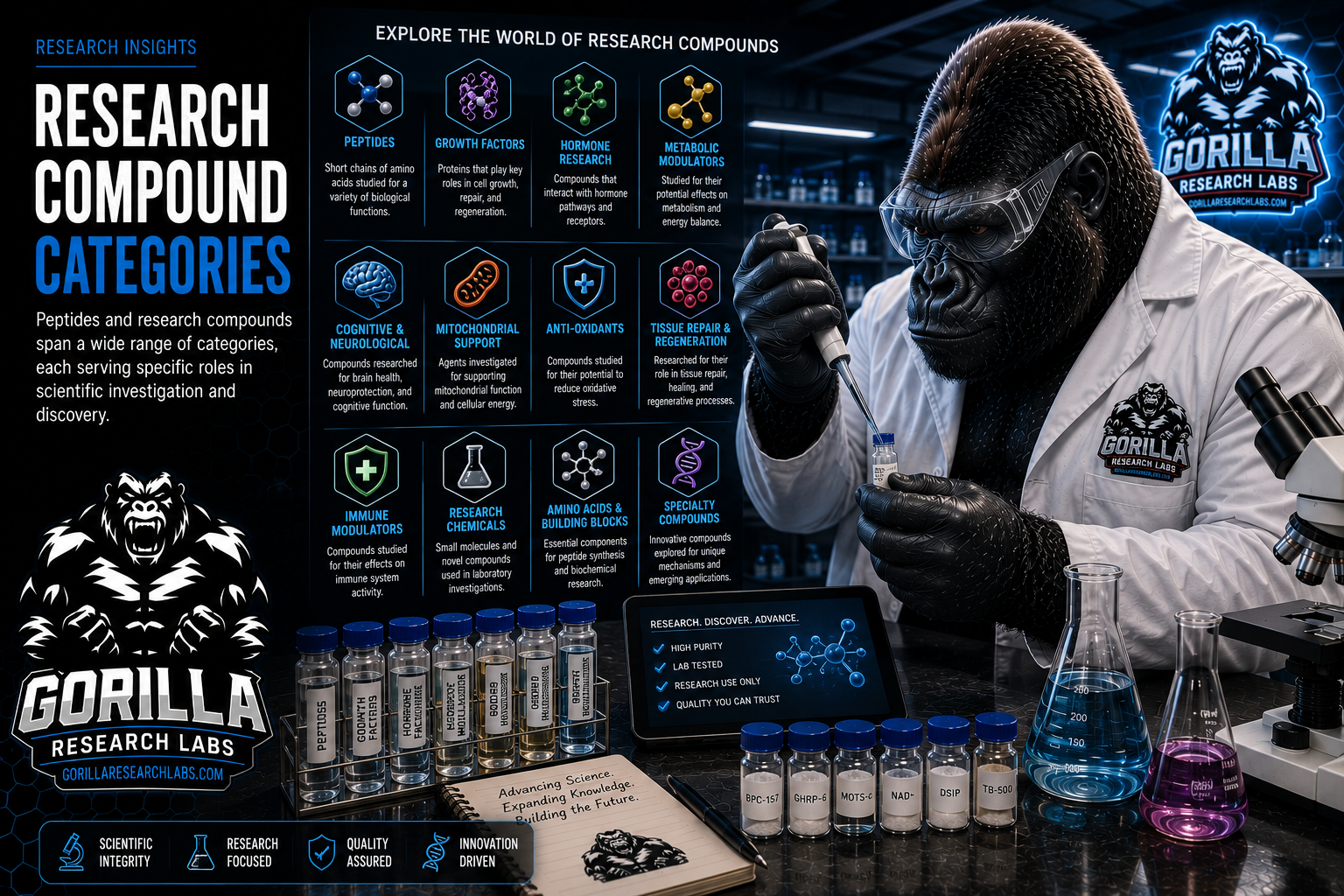
Anyone building a research peptide inventory quickly notices that the catalog is not a flat list. Compounds cluster into families defined by molecular structure, synthesis route, and the kind of laboratory question they were designed to support. A working taxonomy makes the landscape legible: it helps researchers compare like with like, document their materials precisely, and organize a bench or a database in a way that scales. This survey maps the categories most commonly encountered, described strictly by structure and study purpose, and pairs with our broader "what are research peptides" overview.
Signaling Peptides
Signaling peptides are short amino-acid sequences that, in the biological systems they were characterized in, correspond to messenger molecules. In a research setting they are of interest as structurally defined reference material for studying receptor interaction, molecular recognition, and pathway mapping in vitro. Classification here is driven by sequence identity and the receptor family a peptide is associated with in the literature, not by any outcome.
Growth-Factor Mimetics
Growth-factor mimetics are synthetic sequences designed to resemble a region of a larger native protein. Because a full growth factor is often large and difficult to produce, researchers frequently work with a smaller mimetic that reproduces a specific structural motif. As a category they are grouped by the parent protein they model and by the structural domain they represent, which makes them useful as consistent, well-characterized comparison material.
Fragments
Fragments are defined portions of a longer peptide or protein sequence. A fragment is named by the residue range it spans, and that numbering is itself the classification system. Working with fragments lets a laboratory isolate one structural region for study rather than the whole molecule, which is valuable when investigating structure-activity relationships or mapping which part of a sequence a reagent recognizes.
Cyclic vs Linear Peptides
One of the most fundamental structural distinctions is whether a peptide is linear or cyclic: • Linear peptides have free N- and C-termini and an open chain. They are the default form and are typically simpler to synthesize and characterize. • Cyclic peptides are closed into a ring, joined head-to-tail or through side chains. Cyclization constrains the molecule's three-dimensional shape, which changes its structural rigidity and stability profile. This binary is one of the first attributes a researcher records, because conformation influences how a compound behaves as a study material.
Tagged and Labeled Peptides
Tagged or labeled peptides carry an added chemical group that makes them detectable or capturable. Common categories include fluorescently labeled peptides, biotinylated peptides, and isotope-labeled variants. The tag does not change the classification of the core sequence; instead it defines a sub-category built for a specific detection method such as imaging, affinity capture, or mass-spectrometry-based tracking. Researchers select a label based on the instrumentation and assay format in their workflow.
Reference Standards
Reference standards are highly characterized compounds supplied with detailed specification data, intended as a known point of comparison. Their defining feature is documentation: purity determination, identity confirmation, and lot-specific analytical certificates. They anchor method development, instrument calibration, and quality-control workflows, and are classified less by structure than by the rigor of their accompanying characterization.
Reading Across the Categories
These groupings are not mutually exclusive. A single compound might be a cyclic fragment of a signaling peptide supplied as a biotinylated reference standard. That is the point of a taxonomy: each axis, structure, origin, modification, and documentation, is an independent descriptor, and a well-labeled research material can be placed on all of them at once. Cataloging compounds this way keeps an inventory searchable, makes procurement decisions clearer, and supports precise record-keeping. For laboratory research use only. Not for human or animal consumption. Not a drug, supplement, or medical product. No statements have been evaluated by the FDA, and nothing here is intended to diagnose, treat, cure, or prevent any disease.
References
- National Center for Biotechnology Information — Peptides (StatPearls)
- PubMed — Therapeutic peptides: current applications and future directions
- NCBI Bookshelf — Molecular Biology of the Cell: Signaling
- PMC — Cell signaling pathways and receptor biology
Authoritative sources cited for research context. Research use only — not medical advice.