
GHK-Cu 100mg (Copper Tripeptide-1)
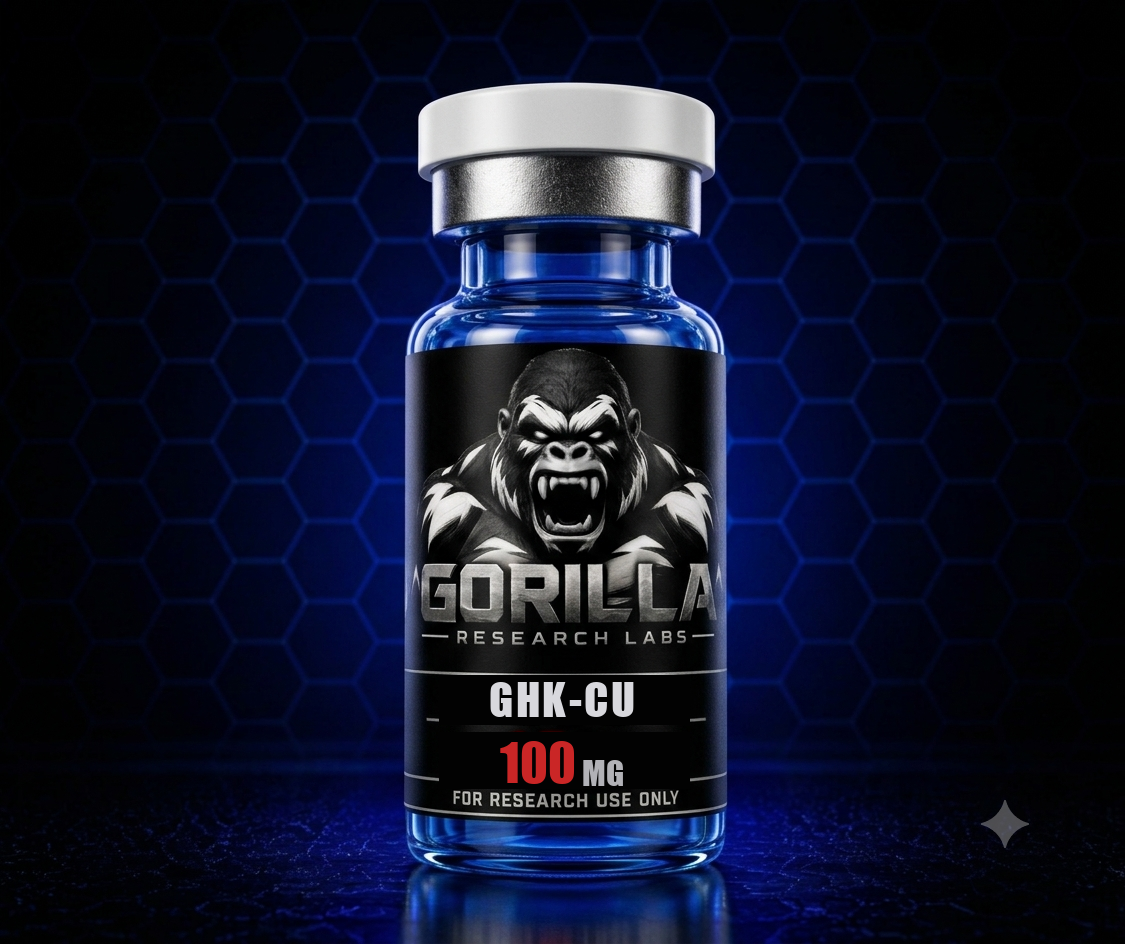
GHK-Cu 100mg is a high-purity research peptide consisting of the naturally occurring tripeptide glycyl-L-histidyl-L-lysine bound to copper (II).
This peptide has attracted significant scientific interest due to its role in:
Researchers commonly investigate GHK-Cu in studies involving tissue regeneration, collagen synthesis pathways, cellular signaling, gene regulation, oxidative stress responses, and age-related biological processes. The peptide's strong affinity for copper allows it to participate in n umerous biochemical pathways that continue to be explored in modern research.
For research purposes only
Specifications
| Compound | GHK-Cu 100mg (Copper Tripeptide-1) |
|---|---|
| Category | Peptide |
| SKU | GHK-Cu-100mg |
| Unit size | 100 mg |
| Price | $50.00 |
| Availability | In stock |
| Intended use | Laboratory research use only |
Compound identity
Reference facts for the compound itself, from PubChem (NIH). They describe the molecule, not a specific batch — batch purity, where a certificate exists for the batch, is reported on it.
| PubChem name | Copper tripeptide |
|---|---|
| PubChem CID | 139035031 |
GHK-Cu 100mg (Copper Tripeptide-1) is also written GHK-Cu, GHK-Cu peptide, GHKCu, GHKCu peptide and GHK Cu.
Details
- Cellular communication
- Extracellular matrix remodeling
- Copper transport mechanisms
Research questions about this compound
What is the primary role of GHK-Cu in research?
In research, GHK-Cu is primarily studied for its ability to bind copper and its potential role in modulating the biochemical environment of wound healing and tissue repair .
Is GHK-Cu considered a proven treatment for skin conditions?
Current research on GHK-Cu is largely confined to animal models and in-vitro studies, which examine its biochemical influence on tissue repair . It is not established as a clinical treatment for any specific condition in human populations .
How does GHK-Cu interact with collagen?
Evidence suggests that GHK-Cu may assist in the activation of lysyl oxidase, an enzyme necessary for the cross-linking of collagen and elastin, which is a mechanism-only finding observed in laboratory settings .
Are there human clinical trials for GHK-Cu?
The available literature focuses heavily on experimental wound models and mechanism-only studies; while GHK-Cu is a naturally occurring peptide, the body of evidence does not support broad clinical claims regarding human health outcomes .
labels, lab notebooks, reorders
GHK-Cu 100mg (Copper Tripeptide-1) — Reconstitution Calculator
For laboratory research use only. This tool computes the concentration of a reconstituted research solution and the volume that contains a target mass. Vial mass is a product specification, not a dose. It is not medical guidance and does not describe administration to humans or animals.
For laboratory research use only · not for human or animal use. Doses-per-bottle is pure arithmetic (vial mass ÷ target amount), not a dosing recommendation.
Compare GHK-Cu 100mg (Copper Tripeptide-1) and GHRP-6 10mg catalog facts →